
My Outline Process: Feature
happy holidays!

i’ve seen a bunch of posts asking about writing process / outline process, etc.
a few people have reached out and asked me to share mine - so here i go.
first and foremost, you have to do what’s best for you. full stop.
read a lot about what other people do.
trial and error a lot.
then figure out what works best for you and your flow.
Here’s how I do it. I’m gonna start with the idea and take you all the way to draft.
every step in this process exists to give me confidence before i open up final draft.
first, i want to say that my process is a combination of others’. I’ve stolen without a hesitation, from people i admire, and put together what works for me.
my biggest influences for my feature process come from:
peter dunne and his book: emotional structure. i always reread before/as i’m starting a new script.
michael arndt and his videos about writing, which can be found on youtube. I keep a page open on my computer whenever i’m writing. i always rewatch.
i specifically love the insanely great ending videos.
dan harmon and his madness of the story circle, which i had the pleasure of seeing and learning from live and in person for three seasons on Community.
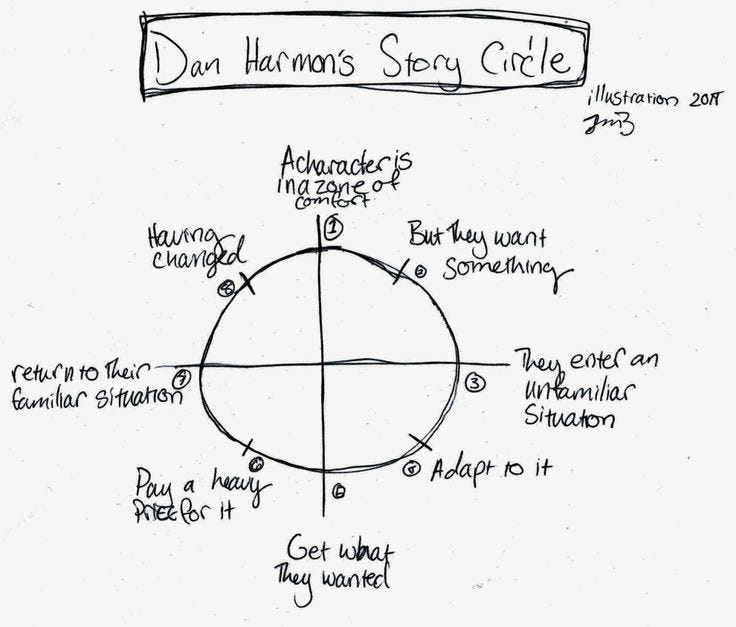
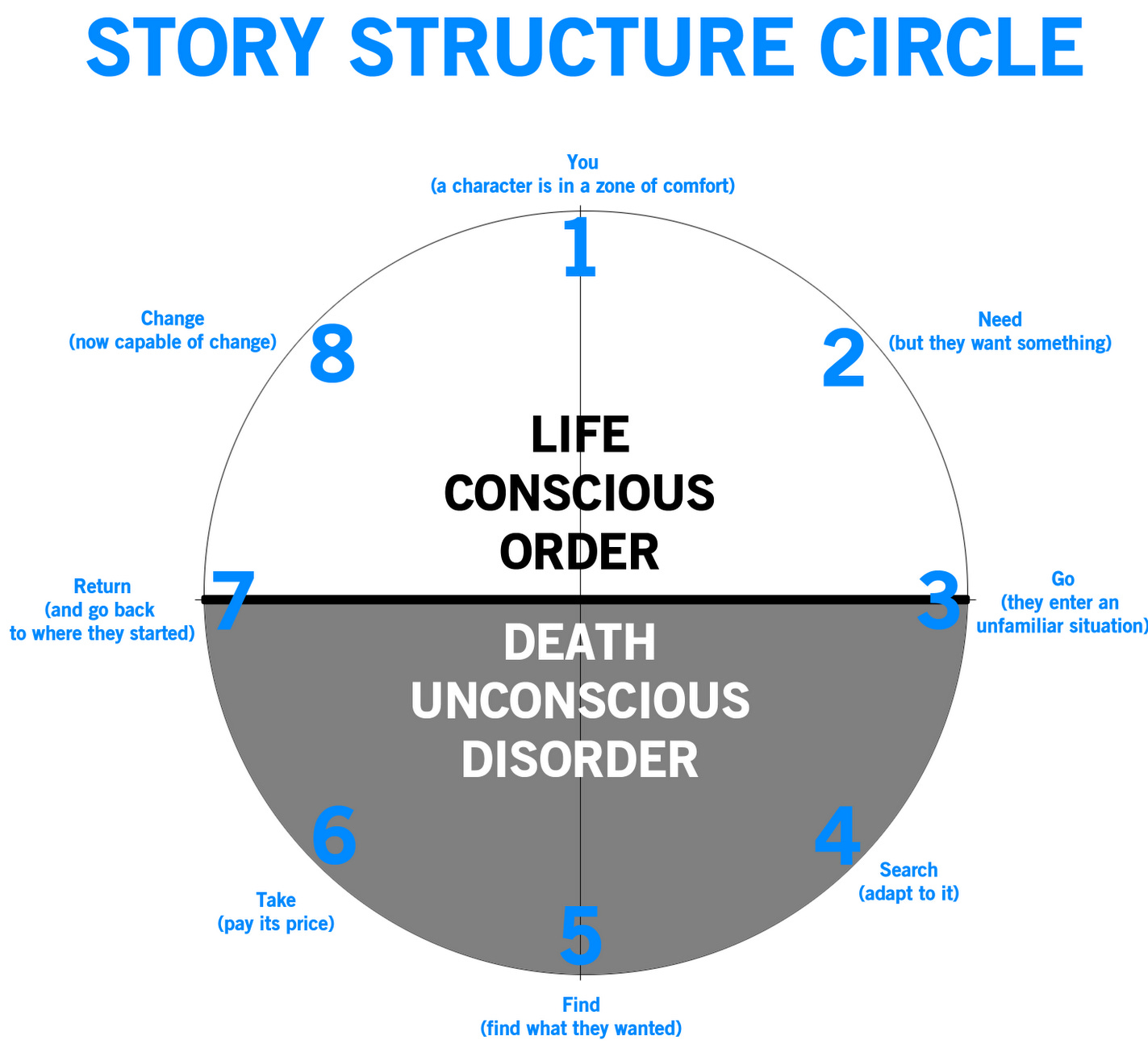
okay, so here’s where we’re going in our journey of this lil’ post:
CRIN
3-liner
3-pager
cards
one-liner / two-liner
emotional outline
smush draft
first thing I do after i have the concept or character is figure out the other. so like, if i have a character - I figure out where they belong / what concept would be fun to put them in.
if i have a concept, i try to figure out a strong character to fill this world.
I do not move on until i have both fleshed out as much as possible.
then i start a C.R.I.N. document.
C.R.I.N.
Characters, Research, Ideas, & Notes (CRIN). each gets their own subheading in the doc
characters - i write out all of the characters, and figure out as much as I can about them.
I free write, no idea is a bad idea
research i feel like this is self-explanatory
ideas - any ideas i have for the concept, scenes, an opening, jokes, anything like that goes here
notes - any notes or feedback i get from friends. things I need to remind myself of as i’m developing this character and idea.
at the beginning of the process you should be actively pitching your idea to friends and seeing what they think. can you do it clearly and concisely?
if not, keep fleshing things out.
watch their reactions - their faces won’t lie.
ask questions. listen.
After i feel good about the CRIN, I move on to a 3-liner.
3-liner
I simply try to crystallize the emotional story of the movie in three lines. each act is a line. i write it and rewrite it until I can clearly understand / get what the movie is.
here is an example of a 3-liner from a rom-com i recently wrote:
Line 1
Henry’s love life is not going great – something is missing – a True Love he can really connect with ‘til death do them part.
Line 2
Going on his gut feeling, Henry decides to take a job as a substitute teacher at his former high school and endure the humiliations of all that is the American high school experience, in hopes of winning over his old high school crush – the music teacher.
Line 3
Henry learns life is not suffering and true love is real, he just had to let go and stop trying to control things, which allowed him to connect with his one true person.
Remember, these steps are for you!
This isn’t genius writing - probably could be more elegant - but the emotional story is clear in these lines.
it’s important to get these three lines right - emotionally. Don’t glaze over this. Because i’ve labored over my 3-line - i move onto a 3-pager.
3-pager
this is a story document - not an outline - and not a beat sheet.
it’s written in prose, present tense, and reads like a short story of the movie.
the 3-pager is an expansion of the 3-liner. Each page is an act-ish. Act 1 and 3 are a bit shorter and act 2 is maybe more than a page - there are no hard and fast rules, but those are the rules. And don’t write 4 pages. Like, don’t. It’s a 3-pager!
You’re not solving plot yet - you don’t know exactly what the plot is! This is about the emotional journey of your character.
Things you should ask yourself:
What is the emotional lie the protagonist believes?
What emotional need are they avoiding?
What are they actually seeking beneath the goal?
If this isn’t clear, your 3-pager is not done.
Rewrite it until it is.
What we need to learn in the 3-pager is the protagonist’s CORE WOUND, which birthed his/her CORE FLAW.
Their choices throughout the movie are based on these important character qualities. The flaw drives every bad decision in the plot (which we will figure out later).
The 3-pager should make it impossible to separate plot from psychology.
Whatever your character’s plot goal is, is never the true goal. The character believes the goal will fix them, but the story proves it won’t.
Only emotional truth will.
This needs to be felt in the prose, not explained like a memo.
Don’t label the acts — just show emotional shifts.
act 1: emotional avoidance
act 2: emotional resistance and escalation
act 3: emotional reckoning
Each section should clearly escalate pressure on the flaw, not just stakes.
And the end solves the wound. Not just the plot. This is where most people blow it.
The climax must force the protagonist to choose differently
That choice resolves the emotional lie
if the ending could stay the same emotionally with a different plot outcome, it’s wrong.
Here’s an example from the middle of page 1 of my rom-com 3-pager:
Henry and Blake play catch on their old high school football field as a bummed Henry retells his horrible Union Station rejection – he doesn’t get why this keeps happening, but Blake does. He says Henry tries to force these “moments” with girls he’s dating – he even moved to LA for Katie and that’s just not how love works. Henry really thought all of those girls were The Ones but he’s starting to believe True Loves aren’t real – maybe it’s just a story told to us, like religion. Henry feels bummed. He doesn’t really love his job either and hasn’t made the move to become a music manager like he was hoping. He’s waiting for the right time. During this depressing tangent the ball gets away and Henry has a run-in with some 8th grade punks who lip off and make fun of him and Blake. They’re vicious. Henry, not in his right mind rn, erupts and a fight ensues between Henry, Blake, and the kids. The fight is broken up by a teacher, CARA (28-30), who ends up in the middle of this immature melee. And when the dust settles, Henry’s hand is on her boob. They look at each other – holy shit – Cara! Henry? Long time no see... They went to high school together and Henry’s hand is still on her boob. Ooooooh.
you might say, oh there is plot in there you liar! howie is a liar!
but this isn’t me figuring out the scene beats, this is me letting emotion spill onto the page and seeing what kind of behavior comes out.
there’s a difference.
what the 3-pager is not
a beat sheet or outline.
a pitch doc
scenes
jokes
This will all come later. I promise. In the meantime:
write.
get notes.
rewrite.
rinse and repeat as necessary. until you feel good about where it’s at.
If you’re still with me - amazing. i’m impressed.
Maybe you’re saying to yourself, “howie, I just wanna write and not think, and sip coffee in the morning as the sun rises and my screenplay just flows through my fingers onto QWERTY and into the script."
well, i just love that for you. truly.
but that’s not how it works for me, or any of the people i’ve worked for, tbh.
but here is your chance to go wild.
no rules.
welcome to...
carding.
Oh, but there are some rules.
first - you’re gonna print out your 3pager - have it by your side so you can check-in on your cards. Don’t use this as a crutch though.
do not card in order.
this is your chance to think of any scene idea you can.
go nuts. any idea - write it on a card.
second - the front of the card
this is where you write your scene idea. this is basically a plot move - it’s what happens in the scene.
don’t try and write every little detail on this index card. that’s a fool’s errand.
just write the essence or idea of the scene.
then, turn it over.
third - the back of the card
here you write the emotional beat of where your character is at in the scene.
this is how we track where the character is emotionally throughout the script
Remember, you can use your 3-pager to see where you’re at, but do not card scenes in order.
Do this until you have about 50-60 cards.
fourth - organize your cards.
now, is when you start to put cards in order.
you may see a scene needs a sister card - like a payoff or setup, so look out for those as you’re going.
I like to organize my cards across the floor or table with the headings: A1 A2a A2b A3
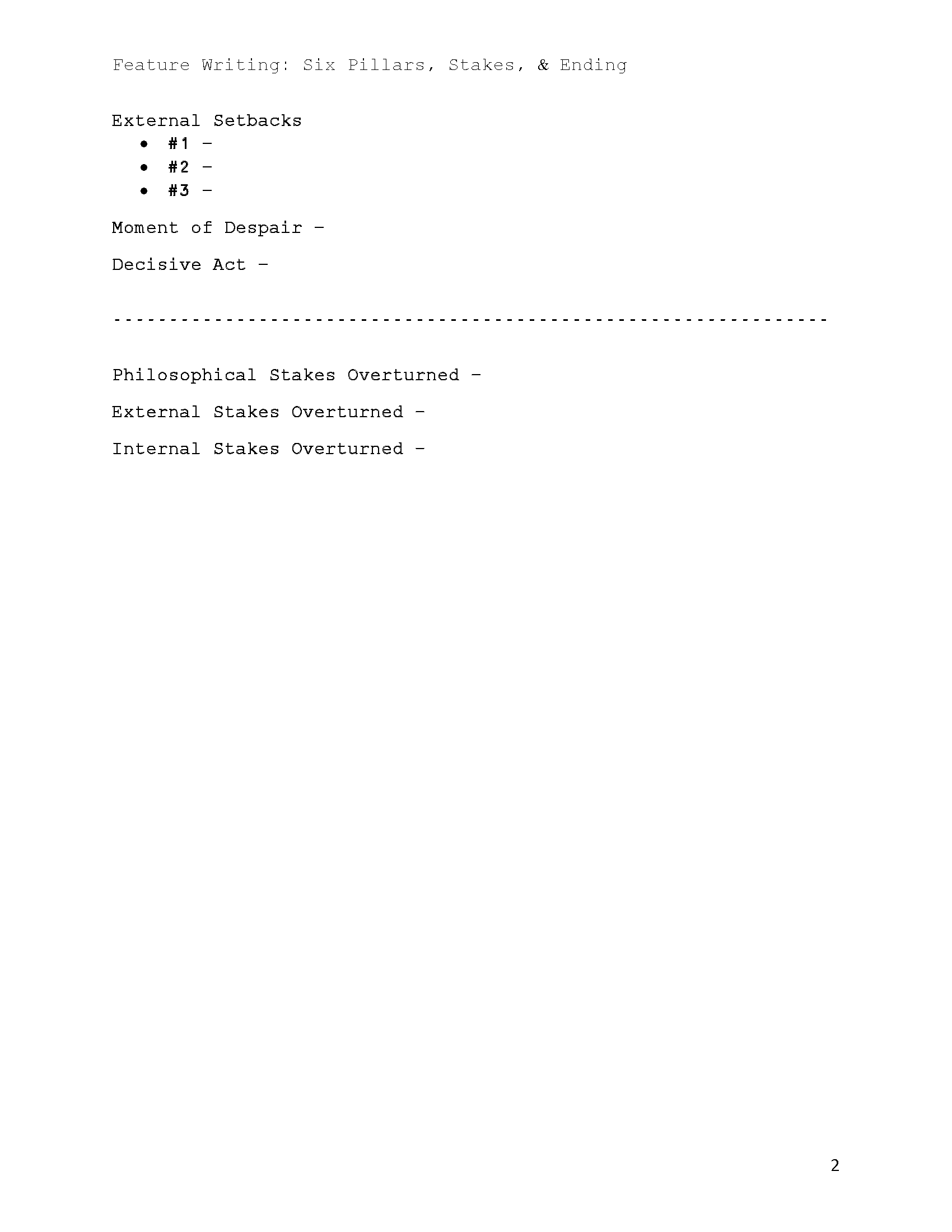
***NOTE**** As I’m carding, and maybe even toward the end of my 3-pager process, I start to think about how I want the movie to end. So, I turn to Michael Arndt and his pillars of an Insanely Great Ending.
An incredible video - all of his are - and a must watch, imo.
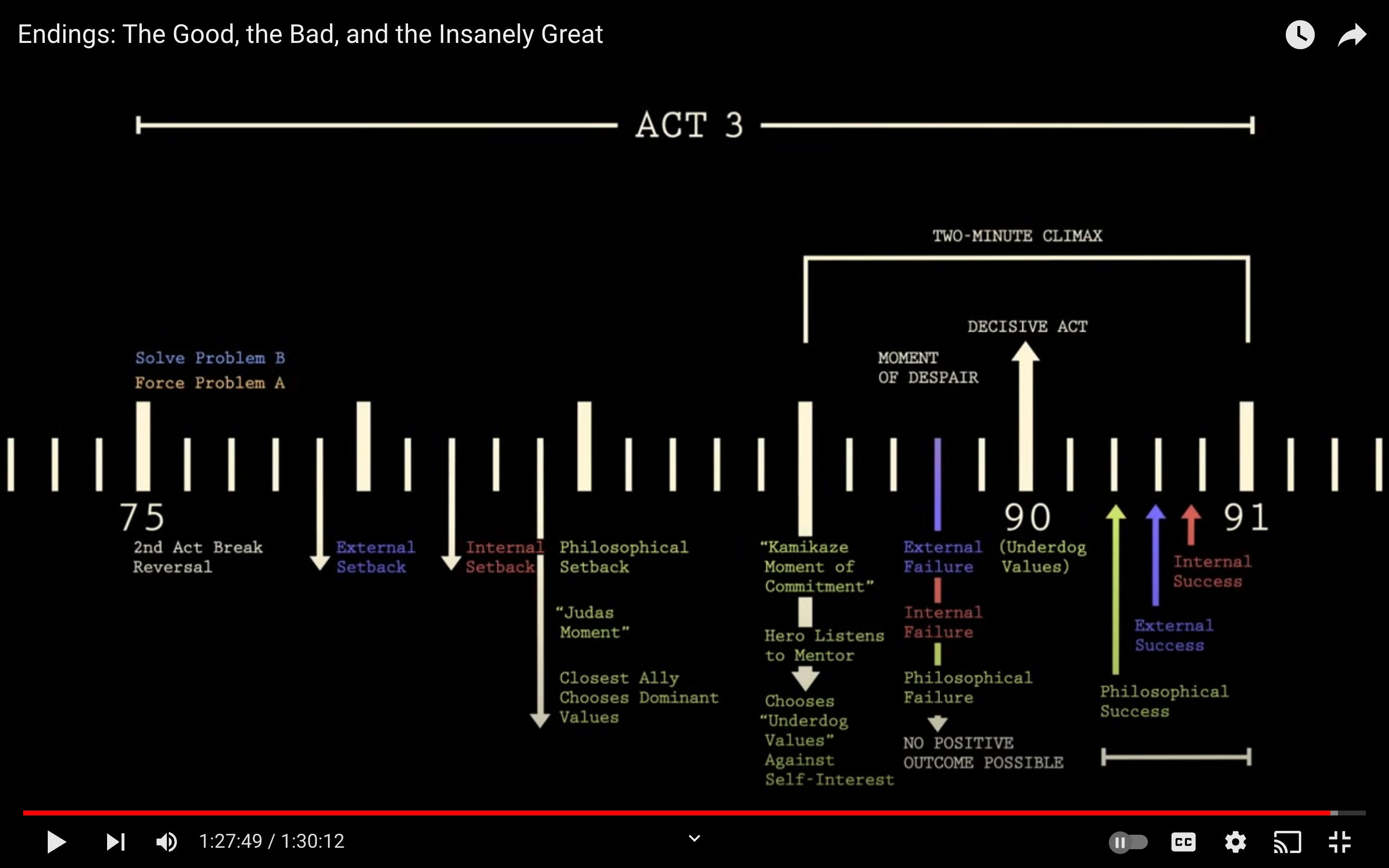
I even made a document of the video. I try to fill it in as I’m going through. I’m always thinking about it, though. The end. How I want my movie to finish. Sometimes, working backwards is a good way to break story - but that’s for another discussion.
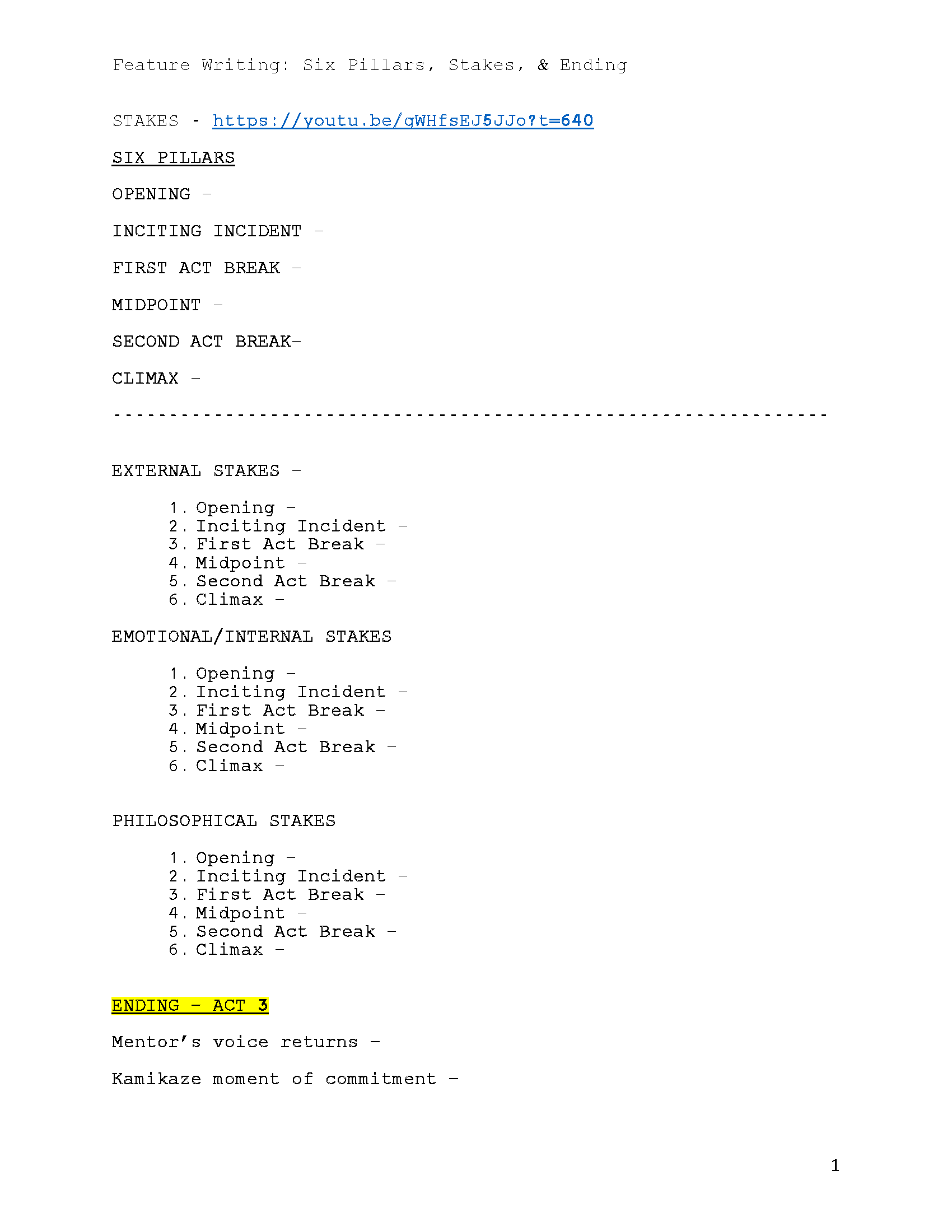
Now we take our cards and move on to the one-liner.
one-liner
open a word document
write act 1, scene 1
take the front of card 1 and write whatever the front of the card says down.
do this for every card, in order. number the scenes.
Then, you’ll have your one-liner.
You can see from a bird’s eye-view what your story looks like. If anything is missing - you can adjust it.
now, we take our one-liner and turn it into our two-liner.
two-liner
same idea as the one-liner, but this time we turn the back of the card over and write the emotional story under each scene.
so, under scene #1, we’d write:
ES: and whatever is on the back of our card. The emotional story.
Here’s an example from my rom-com:
ACT ONE
1. INT. UNION STATION - DAY
HENRY (28) runs through Los Angeles Union Station dodging people, suitcases, and sliding under gates. He sprints and calls out to hold the train. He makes it to the front door just as BROOKE is boarding. He stops and professes his love to her which... she rejects. Brooke boards the train, and it takes off – leaving Henry heartbroken and humiliated.ES: This should feel big. Just like how Henry feels about True Love and being a romantic. There will be a lot of action, diving around people and their luggage. His face needs to show determination – nothing will stand between him and True Love. When he arrives to her, this is grounded, real, heartfelt. Make sure it’s not schmaltzy. A great rom-com speech. This goes from the feeling of ecstasy of catching her in time, to heartbreak, humiliation, and suffering. At the end of the scene, Henry should realize it’s 9:15am and he still has to go to work. Maybe a text from his boss. He gets rejected and then reality smacks him in the face.
do this for every card.
Then, print and read. make sure the emotional story tracks.
I am definitely checking my Arndt pillars here!
making sure the ending is insanely great.
rewrite if there are any gaps.
get notes.
rewrite.
rinse and repeat as necessary.
Once you feel like you’re in a good place, we hit our EMOTIONAL OUTLINE.
Some people will want to go to draft from here. they’ll think they’re ready, but you’re probably not!
i’m an outline guy. this entire process has been leading up to this. and if you do it right, you’ll be golden when you finally go off to draft.
emotional outline
what we do now, is take our 2-liner, and expand it.
You can fill in the details of each scene. If you’ve got comedy bits you want to put in, here is your chance to try them out.
spend time on this document. it’s important.
at the end, ofc check it against the Arndt pillars.
get notes
rewrite.
do this until you really feel strong about the story.
then you can go off to draft.
i like executing one act at a time from the outline.
i rewrite it until i feel good about act 1.
then, i move on to the next act and do the same thing.
I don’t rewrite the previous act, if an idea or something pops up for me - i just make a note of it and address it later.
for me, this is all about getting the emotional outline out and into draft form.
so i keep pressing forward.
once I’m through act 3 - i put all the acts together.
i print and read.
make notes, and rewrite.
this becomes my...
smush draft
now, I’ve got a draft!
writing a feature for most people is like an ant looking up at a giant mountain. it just seems impossible.
this process is meant to make writing a feature underwhelming.
it’s broken down into different very achievable steps.
and i love that.
it works for me.
This process has not only helped me track the emotional story of my characters - it’s given me confidence.
i can write a movie!
and confidence is everything because writing is so so hard.
I know if i do these steps and trust in this process, i’ll have a script i can work from.
writing a clear script is like pushing a reader off of a mountain. our job is to give them every handhold possible so they can pull themselves up to the top.
hopefully i’ve given you some tools to help your falling reader.
take what serves you - make it your own.
Please let me know what you think or if you have any questions!
And if you have a different process - i’d love to hear how you do things!
happy holidays!
Love the idea of tracking the emotional beats on cards!!
i’m definitely (unapologetically) stealing some of these ideas!! Especially the cards one